
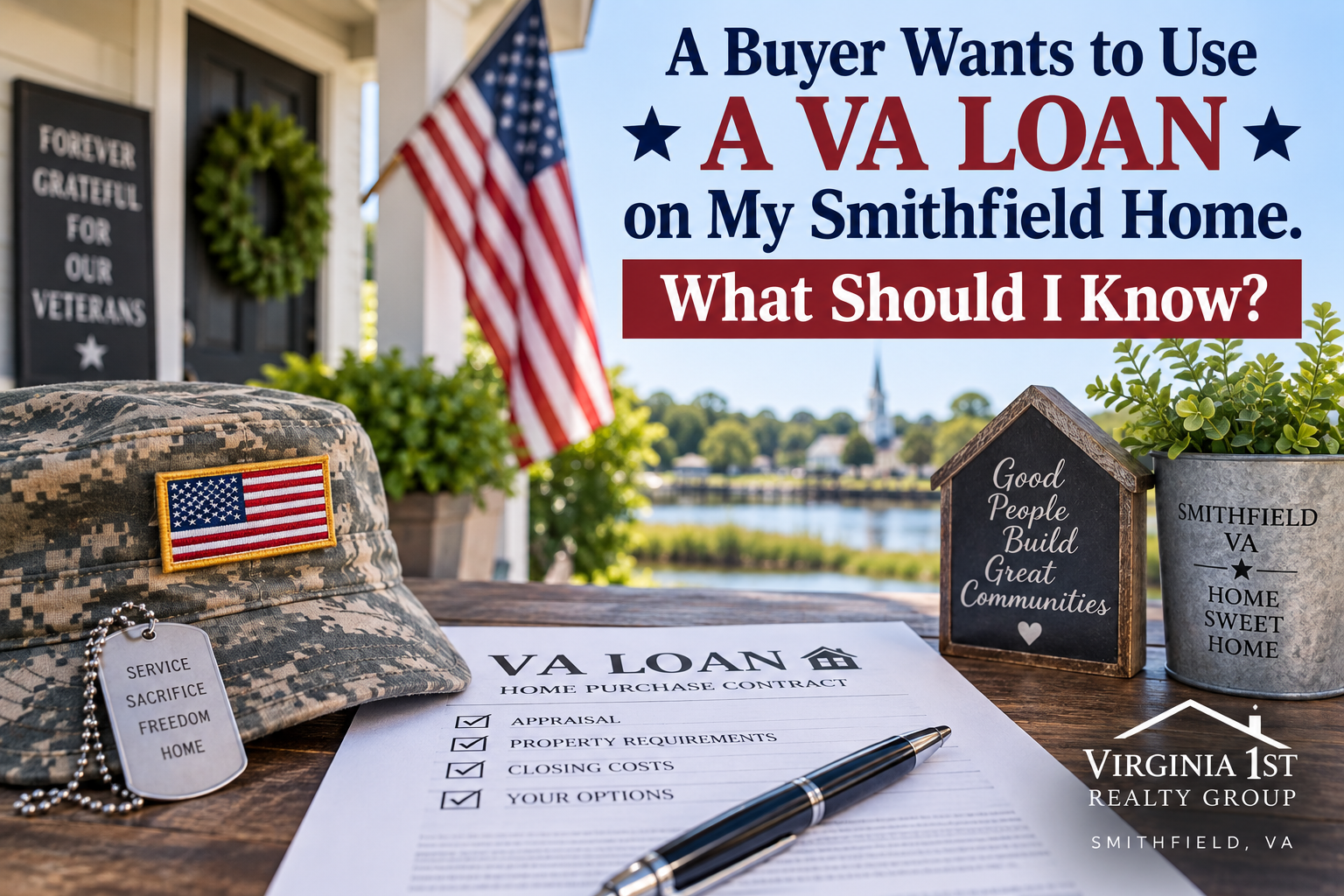
Short answer: A VA-financed offer isn’t automatically harder, weaker, or more expensive for the seller.
There are a few VA-specific rules we need to understand, especially around the appraisal and property condition. But I wouldn’t look at an otherwise good offer and get nervous just because the buyer is using VA financing.
I’d look at the offer the same way I look at any other one:
What’s the price? What are the terms? How solid is the financing? And how likely are we to get to closing?
That tells me a lot more than the name of the loan.
Does a VA Buyer Have to Put No Money Down?
No.
A VA-backed loan can allow an eligible buyer to purchase without a down payment, but that doesn’t mean every VA buyer puts zero down. VA says nearly 90% of its VA-backed loans are made without a down payment, but the actual loan structure is between the buyer and their lender.
As a seller, I’m less interested in making assumptions about the down payment and more interested in whether the buyer is properly qualified.
I want to see a solid lender letter.
I want to know the lender has actually talked with the buyer.
And I want to understand anything in the financing that could affect our transaction.
Is the VA Appraisal Harder Than a Regular Appraisal?
This is probably the biggest concern I hear.
The VA does require an appraisal.
That appraiser does two basic things:
They provide an opinion of value, and they look to make sure the property meets VA’s Minimum Property Requirements, commonly called MPRs. VA describes those requirements as basic standards intended to make sure the property is safe, sound and sanitary.
But a VA appraisal is not the same thing as a home inspection.
That’s an important difference.
The buyer can still hire a home inspector, and VA itself recommends that buyers do so.
Does My House Have to Be Perfect for a VA Loan?
No.
This is probably one of the biggest myths.
An older house can sell with VA financing.
A house does not need a brand-new kitchen.
It doesn’t need new carpet.
It doesn’t need the newest HVAC system.
The VA is mainly concerned with certain property-condition standards tied to safety, sanitation and soundness.
And those standards aren’t frozen in time.
VA updated its Minimum Property Requirements in 2026, saying the changes were intended to remove outdated rules, reduce delays and help VA buyers compete more effectively.
So when somebody tells me:
“VA loans are too difficult because the house has to be perfect,”
I wouldn’t agree with that.
It’s more accurate to say the property needs to meet the applicable VA requirements.
What If the Appraiser Finds a Problem?
Then we deal with the actual problem.
Maybe something needs to be repaired before closing.
Maybe it doesn’t.
I don’t want to start fixing things just because we think a VA appraiser might complain about them.
That’s the same way I approach repairs in general.
Let’s identify the issue first.
Then decide what makes sense.
If we already know the house has an obvious safety or condition problem, we should probably talk about that before accepting any offer — VA, conventional or otherwise.
The same idea applies when deciding which repairs are worth handling before you ever list the house.
What If the VA Appraisal Comes in Low?
This part is important.
VA purchase contracts include what VA calls the escape clause or VA option clause. It gives the VA buyer an option not to proceed at a price above the VA-established reasonable value.
That doesn’t mean the transaction automatically dies if the appraisal comes in low.
VA lists several possible paths:
- Ask for a Reconsideration of Value
- Renegotiate the sales price
- Have the buyer pay the difference between the appraised value and sales price with additional cash
Sound familiar?
It’s very similar to the low-appraisal conversation we’ve already talked about with other financed offers.
A low appraisal creates a decision.
It doesn’t automatically dictate the answer.
Does the Seller Have to Pay the VA Buyer’s Closing Costs?
No.
This is another myth I hear from time to time.
VA says buyers and sellers can negotiate who pays many closing costs. VA also allows sellers or builders to offer credits toward some or all of a buyer’s closing costs.
There is an important distinction between ordinary closing-cost credits and what VA calls seller concessions.
VA currently limits certain seller concessions to 4% of the loan amount. Not every seller-paid cost falls under that 4% limit, which is why I’d want the buyer’s lender involved when we’re structuring the offer.
That’s something I’d let the buyer’s lender help us structure correctly.
I don’t want to guess at loan rules while we’re writing an offer.
So Does a VA Offer Cost Me More as the Seller?
Not automatically.
Suppose we have two offers.
Offer A
$425,000
VA financing
No closing-cost request
Good earnest money
Closing date works
Offer B
$425,000
Conventional financing
$10,000 closing-cost request
Different inspection terms
Which one is better?
Just like an offer below asking price, the headline number or label doesn’t tell us the whole story.
You can’t tell me based on the words VA and conventional.
We need to read the offers.
This is why I keep coming back to the same thing:
The financing type is one part of an offer. It isn’t the whole offer.
What Should I Look at When Comparing a VA Offer?
I’d look at the same things we’ve been looking at throughout this series:
- Purchase price
- Seller-paid closing costs
- Financing strength
- Earnest money
- Inspection terms
- Appraisal terms
- Closing date
- Other contingencies
- Your estimated proceeds
- The likelihood of actually getting to closing
And I’d want to know something about the lender.
An experienced lender who understands VA loans can make a big difference.
The cheapest-looking lender on paper doesn’t help us much if nobody returns a phone call when we have a problem three days before closing.
One Important Fair-Housing Point
This is worth mentioning because we’re in Virginia.
Virginia’s Fair Housing Law protects both military status and source of funds. The law prohibits refusing to sell or negotiate, or applying different terms, because of those protected characteristics.
So our job isn’t to judge a buyer because they served in the military or because they’re using a lawful benefit.
Our job is to evaluate the actual offer and transaction terms.
That’s the right way to do it anyway.
What I’d Tell a Smithfield Seller Sitting Across the Table From Me
If you get a good offer and the buyer is using VA financing, I wouldn’t automatically push it aside.
Let’s read it.
Let’s look at the lender.
Let’s look at the appraisal risk.
Let’s look at any closing-cost request.
And let’s think about the condition of the house.
If there’s something in the offer I don’t like, I’ll tell you.
But “It’s a VA loan” by itself isn’t enough information to tell me whether it’s a good offer or a bad one.
We need the rest of the story.
Thinking About Selling Your Home?
If you’re thinking about selling in Smithfield, Isle of Wight, Carrollton, Suffolk or elsewhere in Hampton Roads, and you have questions about the types of financing or offers you may see, ask me.
Call or text me at 757-880-7061 or email me at [email protected].
I’m happy to explain the differences in plain English and help you understand what actually matters before you make a decision.
Jason Goodin
Principal Broker
Virginia 1st Realty Group
Frequently Asked Questions
Is a VA loan harder for a seller than a conventional loan?
Not automatically. VA financing has its own appraisal and property requirements, but whether an offer is strong depends on the complete terms, buyer qualification and property.
Does a seller have to pay all closing costs for a VA buyer?
No. VA says closing costs can be negotiated between the parties. There are separate rules governing seller concessions.
Does a VA appraisal require my home to be perfect?
No. VA Minimum Property Requirements focus on basic property standards such as safety, soundness and sanitation. A VA appraisal is also different from a home inspection.
What happens if my house doesn’t appraise for the VA buyer’s offer price?
Possible options can include a Reconsideration of Value, negotiating the sales price, or the buyer bringing additional cash.
Can I compare a VA offer with other offers?
Of course. Compare the actual price, terms, financing, contingencies, closing costs and likelihood of closing rather than judging an offer by the loan label alone.
Check out this article next