

Short answer: Don’t reject it just because it’s below asking price.
A low offer isn’t necessarily a bad offer.
Sometimes it’s an opening move. Sometimes it’s the market telling us something. And sometimes, once you look at the rest of the terms, an offer that feels disappointing at first turns out to be pretty good.
The question I’d ask isn’t:
“How far below asking price are they?”
It’s:
“What does this offer really put in your pocket, and what are our other choices?”
That’s a much better place to start.
First, Try Not to Take the Offer Personally
I know that can be easier said than done.
You’ve cleaned the house, gotten it ready, opened it up for showings and probably spent plenty of time thinking about what it’s worth.
Then somebody comes along and offers $20,000 less.
It can feel insulting.
But the buyer probably isn’t trying to insult you.
They’re trying to buy a house.
And just like you want to sell for the best price you can get, they want to buy for the best price they can get.
So before we get mad and throw the offer away, I’d rather see what we actually have.
Asking Price and Market Value Aren’t Always the Same Thing
Your asking price is where we decided to start.
The market still gets a vote.
Maybe we listed at $425,000 and the first offer comes in at $410,000.
Does that mean the house is only worth $410,000?
Not necessarily.
But it is information.
I’d want to know:
- How long have we been on the market?
- How many showings have we had?
- Have we received any other offers?
- What have buyers been saying?
- What have similar homes sold for?
- What new competition has come on the market?
- Is this buyer serious and qualified?
Those answers matter a lot more to me than simply saying, “They’re $15,000 low.”
How Much Negotiating Room Do Buyers Have Right Now?
Buyers around Hampton Roads do have more choices than they had a year ago.
REIN reported 6,120 active residential listings in August 2026, up 7.2% from August 2025. Median days on market was 27 days. At the same time, the regional median sales price was still up year over year, from $370,000 to $388,950.
What does that mean in plain English?
Buyers have more choices, but that doesn’t mean sellers have lost all their leverage.
It means we should expect some negotiation.
A buyer may feel more comfortable testing the waters with an offer below asking price when they know there are other homes available.
That’s not automatically a reason to accept it.
But it is a reason to take the offer seriously enough to look at the whole thing.
Should I Counter the Offer?
A lot of the time, yes.
If a buyer writes an offer that’s lower than we want but everything else looks good, a counteroffer may be the obvious next step.
Maybe they offer $410,000.
We counter at $422,000.
They come back at $417,500.
Now we’re having a real conversation.
You don’t have to choose between:
“Take it.”
and
“Reject it.”
There’s a whole lot of room in between.
Negotiation is normal.
But Price Isn’t the Only Thing We’re Negotiating
This is where I really want sellers to slow down.
Suppose you get two offers.
Offer A
$420,000 purchase price
But the buyer wants:
- $10,000 toward closing costs
- Several pieces of personal property
- A long inspection period
- A home-sale contingency
Offer B
$414,000 purchase price
But:
- No seller-paid closing costs
- Strong financing
- Clean terms
- Closing date works perfectly for you
Which one is better?
You can’t answer that from the price alone.
We have to look at the net proceeds, the terms, and the chances of actually getting to closing.
That’s why I don’t get overly excited about the highest number until I’ve read the rest of the offer.
What If the Offer Is Really Low?
There’s a difference between an offer that’s below asking and an offer that’s way out in left field.
If you list at $425,000 and somebody offers $300,000, we may not have much to talk about.
But even then, I usually prefer to understand the situation before reacting emotionally.
Maybe there’s a reason.
Maybe there isn’t.
If the buyer is serious, we can always counter with something that makes sense to us.
If they aren’t serious, we’ll find out pretty quickly.
A low offer doesn’t force you to do anything.
What If My House Just Hit the Market?
Timing matters.
If the home went active yesterday and we already have strong showing activity, I may feel very differently about a below-asking offer than I would after 45 days with very little interest.
If we have five more showings scheduled for the weekend, we may have options.
If we’ve been sitting for two months and this is the first buyer willing to write an offer, I’m going to pay attention.
That doesn’t mean we give the house away.
It means the offer has more information behind it.
A home that has been sitting for a while may also need a fresh look at its pricing strategy.
What If We’re Getting Showings but This Is Our First Offer?
That’s another clue.
If plenty of buyers have toured the home but nobody else has written, this first offer deserves a close look.
Maybe the buyer is simply trying their luck.
But maybe their number is closer to where buyers see the value than we hoped.
That’s when I want to look back at the feedback.
If several buyers have said:
“Nice house, but it feels high for the condition,”
and now our first written offer comes in below asking price, those two things may be connected.
The market doesn’t always send us a formal letter explaining what it thinks.
Sometimes we have to put the clues together.
What If I Think My House Is Worth More?
You might be right.
And sometimes my advice will be:
Don’t take it.
Maybe we’re priced well.
Maybe the activity has been strong.
Maybe comparable sales support our price.
Maybe we have other interested buyers.
Maybe the offer simply isn’t good enough.
I’m not in the business of talking a seller into taking every offer that comes along.
But I also don’t want to lose a good buyer over a number we might regret later.
There’s a balance.
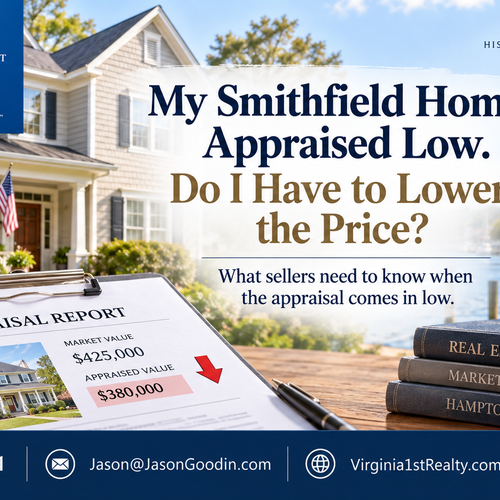
Could the Appraisal Become a Problem If We Push the Price Higher?
It could.
Suppose a buyer offers $415,000 and we negotiate them all the way up to $430,000.
Great.
But now the home still has to support that price if the buyer is financing the purchase.
If comparable sales don’t support it and the appraisal comes in low, we could end up right back at the negotiating table.
So getting the highest possible contract price isn’t the only goal.
I want a price we have a reasonable chance of actually closing.
That matters.
What I’d Tell a Smithfield Seller Sitting Across the Table From Me
If you get an offer below asking price, don’t get mad and don’t get scared.
Let’s read it.
Let’s run the numbers.
Let’s look at what else the buyer is asking for.
Let’s look at what the market has been telling us.
Then we can decide whether to accept it, counter it or walk away.
Sometimes I’ll tell you:
“That’s better than it looks.”
Sometimes:
“Let’s counter.”
And sometimes:
“Nope. I wouldn’t take that.”
What I don’t want to do is make a big financial decision because somebody’s first number hurt our feelings.
Real estate negotiations work better when we keep our heads and look at the whole deal.
Thinking About Selling Your Home?
If you’re thinking about selling in Smithfield, Isle of Wight, Carrollton, Suffolk or elsewhere in Hampton Roads and you’re wondering what today’s buyers may ask for — or how I’d handle an offer when it comes in — ask me.
Call or text me at 757-880-7061 or email me at [email protected].
I’m happy to talk through your situation and give you a straightforward answer.
Jason Goodin
Principal Broker
Virginia 1st Realty Group
Frequently Asked Questions
Should I automatically counter a below-asking offer?
No. Sometimes accepting the offer makes sense. Sometimes a counteroffer does. I’d first look at the price, terms, buyer strength, market activity and your goals.
How far below asking price is considered a lowball offer?
There isn’t one percentage that applies to every house. An offer that’s 5% below asking might be unreasonable on a newly listed, well-priced home with multiple interested buyers but very reasonable on a home that has been sitting for months.
Should I accept a lower offer if the terms are better?
Possibly. A slightly lower offer with strong financing, fewer contingencies and no seller-paid closing costs can sometimes be better than a higher offer loaded with requests.
What if I reject the offer and nobody else comes along?
That’s the risk we have to consider. Before rejecting an offer, I want to understand current buyer activity, competing listings and how likely we are to receive something better.
Does accepting less than asking mean I priced the home wrong?
Not necessarily. Asking price is a marketing decision, and negotiation is part of real estate. The final price is ultimately what a ready buyer and willing seller agree to.
Check out this article next